
Who Will Lead IATA Next?

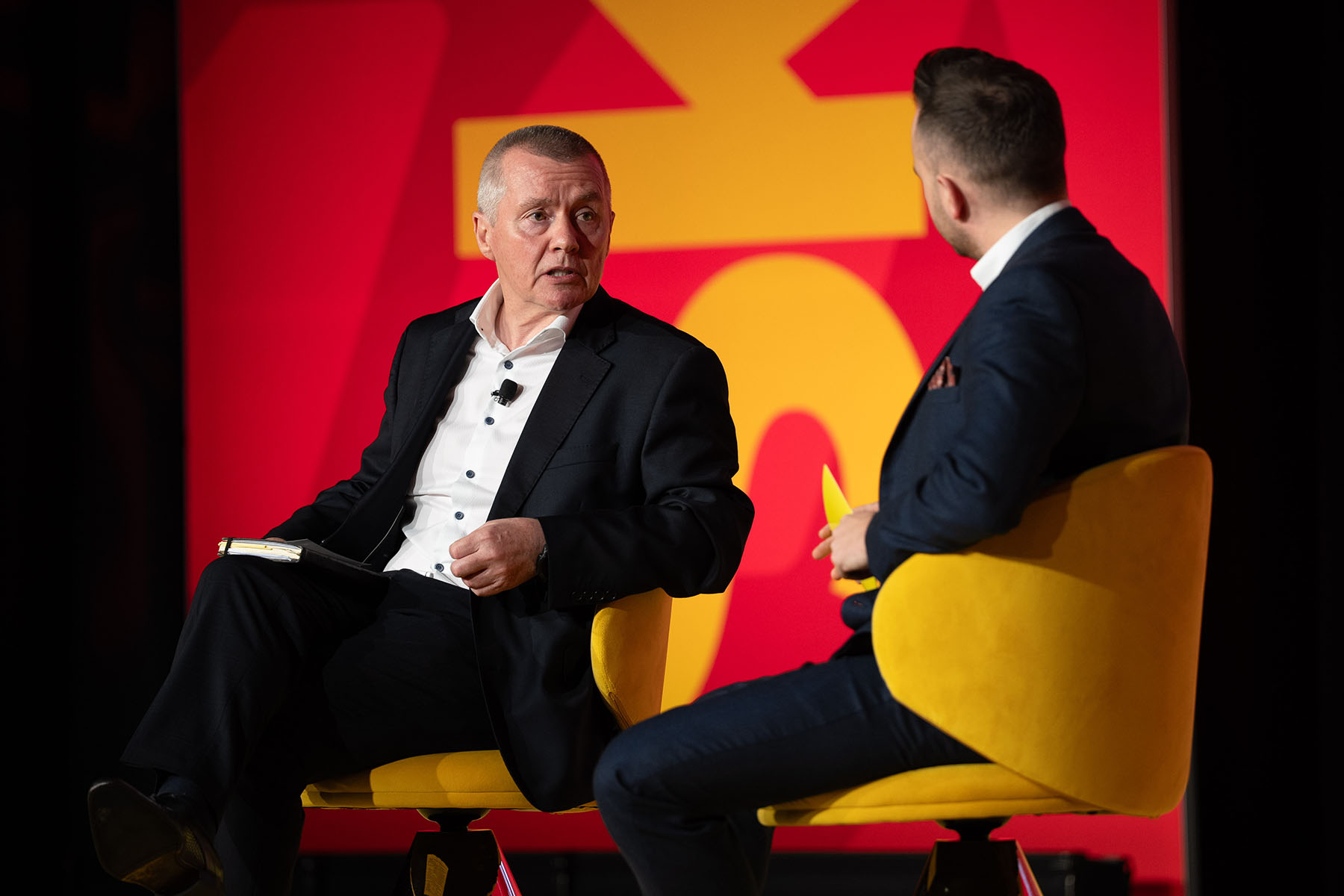
Photo Credit: IATA Director General Willie Walsh in conversation with Airline Weekly's Gordon Smith in November 2024. Skift
Skift Take
The aviation industry is navigating a turbulent stretch of leadership upheaval, fuel cost pressures, and strategic overreach, with Willie Walsh's surprise move to IndiGo and Alaska Airlines' Hawaii-Mexico drag serving as the clearest signals of an industry in flux.
Subscribe Apple Podcasts | Spotify | YouTube | RSS
Gordon and Jay unpack major leadership moves shaping the industry, from Willie Walsh’s shift to IndiGo to Michael Rousseau’s departure from Air Canada. Later, they dive into fuel prices and what’s ahead for Alaska Airlines.
Watch This Episode
Transcript of This Conversation
This transcript is generated by artificial intelligence.
JetBlue Merger Rumors
Hello and welcome to the Airline Weekly Lounge. I'm your host Gordon Smith, and I'm joined as usual by co-host Jay Shabat. In part one, we're talking boardroom reshuffles, and in part two, we're checking in on the latest at Alaska Airlines.
Hi, Jay, how's it going?
I'm great, Gordon, how are you?
Do very well, back in my usual concrete box in Lisbon after my time away. Lovely being out on the road, but no place quite like home, so great to be back. And there was a lot going on.
I know, I think we say this, it feels like every single week at the moment, but there sure is a lot going on. Jay and I were just discussing this morning, my time around, what did we discuss in the show today? We wanted to be topical.
We'll obviously record this on Tuesday, it's March 31st as we're recording this. We know most people will not be listening to this until later in the week.
So we obviously have a little discussion around what we're going to discuss, what we don't discuss, usual editorial stuff. And there were a lot of options. I dare say we could have filled the program three, four times over, Jay.
But we're going to try and be taking off a few of the key stories, maybe not going into the detail that we might normally do, just because there is so much going on. And then part two, a bit of a deeper dive into Alaska Airlines. But where to begin?
Willie Walsh heading to IndiGo, was that on your bingo card?
Hold on a second, Gordon. As you were talking, some breaking news here.
Oh.
American is going to be buying JetBlue.
Should I take a look?
It's not April 1st, but we were close enough that I thought I'd get you there with an April Fool's joke.
I was going to say, yeah, that was... We are told as journalists, not just at Skift, not at Airline Weekly, just across the board, always beware around this time of year.
It's almost our version of journalistic spooky season, because you do get companies that can be a bit mischievous and put out either frankly press releases that are frankly just not true under the guise of an April Fool and others that like to have a
little bit of fun and being economical with the truth. So just to clarify, if anyone switches off the podcast right now, JetBlue, American, they're not quite getting into bed.
As far as we know. I did... They could be talking.
No, and I did got to bring that up and we'll get to IndiGo and be more serious in a moment. But actually, this is very serious here. There are, you know, Blue...
Or who was it? Semaphore, which is an online news organization. They reported that JetBlue is looking at perhaps finding a merger partner.
Don't know if it would be American. That may be a less likely one than United, for example, which we know would love to get back into JFK report.
And we know that United is already partnering with JetBlue, so they possibly could have something in the works. Southwest might be an interesting partner for JetBlue as well.
So I said the joke with some, you know, the reality in the background being the case with this, you know, these merger more than just rumors, apparently, you know, these tangible reports of them looking for a partner perhaps. So that's that.
JetBlue heading back down to the singles bar and sort of putting on the best clothes and sort of saying, hey, I'm out here.
But all the while, United looking across the bar and saying, hey, I thought we had a little something going on, a little early spark, kind of, you know, Johnny Garrity speaking at the IATA AGM in Delhi last year. She said, absolutely not.
This is not a precursor to a merger, as you would expect. And Kirby and Co. saying words to similar effect last year when this Blue Sky partnership was first announced.
But like you said, that semaphore report from last week indicating that there may be a little bit of movement behind the scenes.
I, frankly, for what it's worth, would be surprised if it was American, given how things got, lawyers were getting involved at the end there when that Northeast Alliance broke up and there were lots of toings and froings and allegations and
litigations flying around. That would be a surprise, but stranger things have happened, Jay.
Some of the other carriers that you mentioned there, Natural Synergies United would love to get back into JFK in a meaningful way beyond what's available in the Blue Sky partnership, I'm sure.
But I think anything beyond the semaphore report is frankly speculation at this stage. But we'll certainly keep a very close eye on it.
For sure. Yeah. You were mentioning that IndiGo has a new CEO.
4:42
Willie Walsh IndiGo
Who did you say that was, Gordon?
Some guy. Well, actually, it's quite funny because when I got the market filing, and I've subscribed to various things, so they come in as soon as the market gets them.
Sometimes the press offices and the communications offices can be a little slow, but the market files, because they're usually very sensitive topics that are being discussed at that market level.
They have to come out quickly when the news is announced, because they can move markets, move share prices. So it said, Mr. William Walsh.
I'm like, who the hell is that?
William.
William?
Yeah, that's like when people call me Jason, that's like only my mom calls me that because-
Well, I'm like, who's this outsider that's coming in and sort of sweeping IndiGo off its feet? But of course, Mr. Willie Walsh of, well, how far back do you want to go?
Air Lingus, BA, IAG, and now of course, the Director General of IATA, but not for much longer Jay, because he's swapping Geneva for Gurugram.
Yeah, quite a surprise to me. I kind of assumed that the IATA job was more of a, quote unquote, retirement job.
Yeah, sort of.
Yeah. Exactly. Not that it's not a serious job or it's not.
Exactly. But it's maybe a little less intense than running a giant global airline like IAG or IndiGo, which is one of the fastest growing airlines in the world. So yeah, that was a surprise to me.
And he will have quite a challenge ahead of him. I have to say though, there's probably no more, if you think about the most interesting airlines in the world to run right now, IndiGo has got to be right up there.
Because think about all the new planes that they're getting, including the Y bodies, that the world is your oyster, as far as throwing darts at the route map.
And I mean, they could really, they're going to have the equipment to really go anywhere in the world. And they just have this big mandate for growth. So really exciting times for IndiGo.
And obviously Peter Elbers ran into some trouble there. We don't know all the behind the scenes drama of why exactly he left. But obviously there was that operational meltdown in the fall, or whenever it was in December.
So they felt they had to make the change there. But that's, you know, if you're going to hire a new airline CEO, Willie Walsh, he's on my malrush, Martin, about yours, Gordon. He's, I mean, he's hall of fame material.
Very, very credible candidate, Jay.
And you do wonder when they were scoping out a replacement for Elbers. Yeah, they would have discussed various names.
Who's officially on the market, who may be, so you might pursue them in more of a sort of poaching them out of their current role, sort of capacity.
And I'm sure Willie Walsh was mentioned, and I'm sure there was maybe a few sort of chortles like, oh, he's not going to come to us.
You know, he's doing what you just said, that sort of lap of honor, doing the IATA DG thing, and then off to his Tuscan house for Chianti and gardening and all the other good things, with I'm sure a few non-executive roles and consultancy bits and
pieces. You know, someone like that, you sort of cut them open, they will bleed JA1 fuel. These are just people that you can never really switch off from the industry.
And I speak to a number of senior airline executives who have retired, and they do find that either they get itchy feet or they come back in a consultancy capacity or something. Aviation really is in them.
So I expected Willie to pop up somewhere, but I didn't necessarily think this would be such a huge role that he would be taking on after IATA.
Just to run through some of those dates, currently Director General of IATA, he's in a step down from that position on July 31st and will join IndiGo no later than August the 3rd. So we're not talking a huge amount of time.
We've also got the IATA AGM. That's in early June in Rio. So maybe if IATA can get its doctor in a row by then, we could have the announcement of a successor by the time we get to Rio.
Or I don't know enough about the mechanics. It may be well the case that the board of directors there has various discussions in Rio and then a subsequent decision is announced. So we'll need to watch that.
But my spidey sources in Geneva said that the IATA board of directors has been preparing for a leadership transition and the search for Mr. Walsh's successor is quote, well advanced. So make of that what you will, Jay.
We'll obviously keep our listeners, viewers and readers updated.
Any guesses? I don't. Go ahead.
I would love to see how back there.
I'm not sure if he's the most diplomatic.
No, no, no, no.
I should qualify that. That is not the smart money, but that's the most fun money, I think as someone looking in on the industry.
I've seen how much color that Willie has been able to give to some quite dry topics and actually some quite frankly, IATA can be at times a bit of a dry organization, albeit representing a very dynamic industry.
Willie has been able to bring a lot of energy to IATA. I think I expect the board of directors there will be looking to emulate that to a degree with someone that has got cut through and isn't going to be a dry diplomatic bureaucrat.
Of course, there's going to have to be diplomacy representing hundreds of airlines and stakeholders and everything else, a very, very tight rope to walk. But yeah, I would just love to see Alpaca come and shake things up at IATA level.
But more seriously, Jay, any names that you wouldn't be surprised if they were on the short list?
I don't know. It's a good point you make that, yeah, it is a role that in some ways you have to be diplomatic because you're dealing with governments around the world.
But at the same time, like you said, Willie Walsh is known for his being very blunt and direct. So maybe that's what they'll look for again. Yeah, I guess Akbar would qualify in that category.
So no, I don't have any guesses. Well, I'll just have to wait and see.
Wait and see. But yeah, we'll keep our ears to the ground. Jay and obviously our readers at Airline Weekly will keep them updated as well.
And lots of rumors and the mood music and everything else, whatever analogy metaphor, Jay did a term you want to use around the long-term future of Campbell Wilson at Air India.
I think his contract is up for renewal August 27, but there were previous reports, I think, through Bloomberg, stating that the new owners of Air India, the parent company there, Tata, were perhaps scouting out for someone to come in before then.
We haven't heard much since that initial report, I think that was in January, around Campbell's future at Air India, but who knows, there could be further changes.
And of course, we had more movement at Air India Express in the past fortnight or so, so a very dynamic time for, well, it's probably one of the most dynamic aviation markets there in India, Jay. So more on it when we get it.
And Willie Walsh isn't the only movement that we've had at that sort of senior boardroom level in the past couple of days, Jay.
12:00
Air Canada Leadership
We've got changes at Air Canada as well, the CEO and president, Michael Rousseau. Forgive me if that pronunciation isn't perfectly spot on, but I don't speak French and apparently neither does Michael, to the degree that you might expect.
Hey, maybe he can go to Geneva and take that IATA job, practice.
Okay, a great place to practice.
But yes, in all seriousness, just yesterday as we're recording here, the Air Canada CEO officially retiring, stepping down from the top spot by the end of the third quarter of this year, the company announced that they're working on finding a
potential successor for him. They said they've been doing this for more than two years through quote, a comprehensive internal development program for high potential executives. Wow, there's a bit of corporate jargon if ever I heard it.
The company also revealed that it had kicked off an external search for a new CEO in January.
So, not a complete surprise, but the context here is important because Rousseau's upcoming retirement comes off as obviously we had that tragic Air Canada Express accident at LaGuardia involving a fire truck earlier in the month.
And even the Prime Minister of Canada, Mark Carney, saying that the video statement, the condolence message from Rousseau, quote, lacked compassion.
And you also had the local Quebec officials calling for his resignation because you do have, especially for a company like Air Canada, that is headquartered in Montreal, which is famously a French-speaking city in Canada.
Overall, having two official languages, French and English, it is written into law in many cases that you will have official communications and other public-facing announcements in both English and French.
And this actually goes back a number of years. There were earlier controversies going back, I think, to 2021 and others when he became CEO.
Rousseau telling reporters back then, following a 26-minute speech in English, which included a little French, that he did not need to learn French just by having lived in Montreal for 14 years. So there were also some backlash there.
So officially, it's a retirement case, but I think the broader context is pretty clear to read.
Interesting times for Air Canada. They had a disappointing year last year. They only had an operating margin of 6%.
I think it was less than 6%. And that was down from 8% the year before and 11% from two years before. However, a lot of that disappointment came from one particular quarter, and that was the summer.
Usually, Air Canada thrives during the summer. It's a very seasonal airline, and they tend to run up the score in those warm months, June, July, August. This year, they were unable to do that because of labor strife.
They had a very costly flight attendant strike, so they wound up having a disappointing year.
But their fourth quarter was pretty good, and their start to 2026 looked pretty good too in terms of demand, in terms of, yeah, the premium demand is excellent.
I mean, a lot of things that you hear us talking about for a lot of other global airlines.
So, they had a good start, and unfortunate with obviously tragic what happened at LaGuardia Airport with the accident, and then just unfortunate from a business continuity point of view in terms of the executive turnover here.
And I'm curious to know, just as we're curious to know who's going to fill that IATA vacuum, I'm curious to see who's going to fill the shoes of Mr. Rousseau there in Montreal.
You do, because of that French language requirement, it does limit your pool of executive talent somewhat.
You do have a lot of aviation talent in Canada, because you have big companies like Bombardier, and you have CAE, which is a big aviation training company.
So there's talent out there, but obviously the pool is somewhat limited if you're requiring someone to speak French. Air Canada has been very fortunate in having a couple of very excellent CEOs.
I mean, remember, this was an airline that was bankrupt about 20 years ago, and they really made great strides in turning things around, and they did so by a variety of means.
They just really exploited the internet, a lot of international opportunities from their hubs. Montreal is actually, has been their fastest growing international hub by far over the past couple of years.
They've done a great job of really squeezing a lot of juice out of that hub, and they've done a lot of great work with their loyalty program.
And I can go on, but they have had very good management talent over the years, dating back to even when Ben Smith was there, who's now running Air France, KLM. So obviously to get that job over in Europe, he had to have done a good job at Air Canada.
And Kailan Rovinescu, who's back in the industry now, I believe he's at CAE, if I'm not mistaken. He did a fantastic job as well. So let's see who's next in line.
Yeah, we will follow that closely, Jay.
And worth looking back at some of the Skift Aviation Forum interviews, which some of them are on YouTube, some of them are for subscribers only. Take a look. But we have had, of course, Willie Walsh.
He joined us in December, November, December 2024. And we also had Senior Executive from Air Canada. I think Mark Masser, he was with us recently as well.
He was at AR Aviation Forum.
Exactly right.
That was it. So feel free to take a look at, especially for our subscribers, the Skift Archive for some valuable nuggets in terms of the context around these big names that we have been discussing.
Lots more we could discuss and we will pick up on some of the other news bits after the break, but I just want to jump into the break at this halfway junction.
Before that, a quick reminder to send in questions or comments that you might have for us to podcasts at skift.com. That's podcasts with an S at the end.
And please don't forget to follow or subscribe to the podcast, wherever you're listening or watching.
And if you are enjoying the show, please rate us five stars or leave us a positive review so we can continue to spread the word about the Airline Weekly Lounge. Don't go anywhere, we'll be right back.
Before we head into the break, we're joined by a Skifter that you might not be so familiar with. And that's Adam Stacey. He's a senior editorial event and awards producer.
Whoo, that's a big title. And he's currently working on the Skift Idea Awards. Adam, welcome to the Airline Weekly Lounge.
Thank you very much.
Glowing introduction.
For the benefit of listeners who aren't familiar with the Idea Awards, what are they all about?
Yeah. So, Skift Idea Awards, we're just moving into our eighth year. So the awards were launched really to recognize and celebrate the most impactful ideas across travel, just the entire ecosystem.
But I like to think of them as the travel industry's innovation, Ben Snark. You know, we all know we're at the pivotal moment of transformation for the industry, structurally, technologically, operationally.
And these are awards about spotlights in the companies and leaders who are actually driving that change.
So, you know, I'm talking about things like advancements in customer experience, AI, digital transformation, sustainability, product design, all that good stuff. And what's important with the awards as well is that it's not necessarily about scale.
So we're open to everyone because our focus is about impact. So we see submissions from startups, mid-size players, global brands, you know, individual leaders. I was like to think innovation doesn't correlate with the size of the company.
It correlates with the execution and the results that they're putting out. And that's what we are recognizing with these awards.
Totally agree. Sometimes it helps if you're a little bit more nimble, a bit smaller, you can be a little bit more disruptive than a very large corporation.
But what would you say, Adam, to an Airline Weekly Lounge listener who says, that all sounds great, but where do I fit in? Yeah.
And I'm not an airline expert, so I'm not going to tell people what to do. But I think for this audience, we have an obvious category, which is airlines and airports, it's specifically designed for that industry.
That could cover anything from carbon innovation, distribution strategies, emerging, advanced aimability. We're seeing all this stuff with flying taxis and this crazy stuff. But we also have categories specifically for technology.
So this industry specifically is deep into AI deployment. We're focusing on revenue optimization, workforce planning, retail transformation, data-driven personalization, and sustainability as well.
That's another area where this industry is focused on. So fleet strategy, emissions tracking, new planes, all that stuff.
So we're looking for initiatives really that just demonstrate tangible progress and are bettering the experience for the end user and the industry as a whole.
Sounds great. If anyone's still unsure, I believe you've got a quiz as well.
We do. Our marketing team, I like to call them the best in the biz. They've come up with a quiz that you answer a couple of questions and the quiz will tell you basically which categories are the best fit.
Amazing.
One new thing we've launched this year is where is that you can actually download a sample form before you submit.
So if you're entering on behalf of a client maybe, or you're not quite sure what the submission forms looks like, you can just download a PDF sample and take a look in advance.
Super, super helpful. Okay. You've got everyone interested.
What is the call to action? Where do they go next if they want to apply or learn a little bit more?
Yeah. So the next step is to just head to the website, which is hosted on live.skift.com, and then you just follow through to IDA Awards. As you mentioned, we've got a quiz.
You'll find all of the categories, the sample PDFs, judges, previous winners if you're curious to see who was made in the past, and all of the relevant timelines. The submission process is very straightforward and streamlined.
It's all done remotely via our online system. You can buy now at the lowest rate and continue to edit up until the entry deadline in July. So there's no huge time commitment there.
And one thing I would say is even if you're unsure about whether your project or initiative will qualify, it's worth exploring.
Some, from speaking to past winners, some of the most compelling have come from projects that they didn't think would be a good fit, and then they've gone on to win.
So yeah, if you've got a smart solution that solves a real-world problem, take a look.
We'd love to hear from you. Fantastic. Yeah, sounds great.
Thanks again for coming on to the show, Adam, and telling us all about it. And I can speak for myself for the Global Forum in New York last September.
We got to see for ourselves many of the IDEA Awards winners, and they are from right across the industry. It's not always who you might expect. So yeah, do check that website out, lifedoftskift.com, where you find all the details for the IDEA Awards.
Just scroll down to the bottom of the page, you'll get all the info there. Thanks to Adam for joining us on the show, and listeners hang around, because we'll be talking IAG right after this short break.
Hello, and welcome back to the Airline Weekly Lounge. I'm Gordon Smith, joined as usual by co-host Jay Shabat.
Part one, we'll be discussing various executive moves in the industry, most notably the fact that Willie Walsh, subject to final regulatory approvals, is off to IndiGo, which is something I frankly never thought I would be saying, but there we are.
Stranger things have happened and are happening, and also some changes at Air Canada as well. Jay, we'd be remiss not to touch on the fuel price.
23:53
Alaska Airlines Outlook
I know that was a big topic of some of our earlier conversations. I want to keep our listeners updated there.
That does also feed into our second topic for part two, which is Alaska Airlines, because we know that they are slightly more exposed than some others in the US given their geography. But just give us a quick fuel price update.
Sure. Well, we're still over $100 a barrel in terms of those major benchmarks.
I believe that's true of both WTI and Brent, which is more the European benchmark, that we're still over $100 and the Jeff fuel price, no relief there either in terms of the crack spread, the refining spreads.
So the crisis, quote unquote, goes on, and we see the latest manifestation of that from Alaska Airlines this morning.
Again, we're talking Tuesday, and I can't remember if it came out yesterday or today, but the Alaska Airlines informed to the market that they are going to make less money than they originally expected for the first quarter.
Actually, I should say, they were already forecasting a loss for the first quarter, but now they're expecting a bigger loss. There are two reasons for that.
One is that JetFuel, that's the obvious one, and I'll give you just some numbers that they gave. They said that they're now going to pay, what is it about, close to $3 per gallon for the first quarter, $2.90 to $3.
Remember that JetFuel is a lot more than that right now, but they're just giving a first quarter average. They paid $2.57 in the fourth quarter. We go from $2.57 to probably $3 in the first quarter.
Then if things continue like this throughout the second quarter, which starts April 1st, then we're talking about an even bigger jump for Q2. That's one problem. The other problem is on the revenue side.
I want to be clear that, and they were clear, that Alaska's revenue situation is very good, as we talked about, was the case for most other airlines now. Revenue trends have been very, very positive. Yields have been very strong.
Load factor has been strong. And in Alaska's case, they particularly called out their corporate business as being exceptionally strong. What's not strong, however, disappointingly so, is Hawaii and Mexico.
Interesting.
Remember, since the Hawaiian merger, Hawaiian is a very, very big piece of the overall pie now.
And if you combine that with Mexico, that's about 30% of the entire company's capacity. So it's a big deal. And what's going on is that Alaska said demand has worsened to Mexico because of what happened in Acapulco a couple of weeks ago.
There was some drug-related violence there. So people are not booking as many trips there. And Hawaii, on the other hand, similar situation in terms of demand falling off.
But in that case, more due to Mother Nature, they've talked about flooding, some weather-related issues there. This all happening during a peak spring break travel period for a lot of West Coast schools and, you know, just colleges, whatever.
So it's that those two markets, Mexico and Hawaii, are trending negative right now. And because it's 30% of their overall capacity, it's having a meaningful impact on the whole airline, despite the rest of the network doing very well.
Yeah, dragging that down. And I was following developments in, I think it was part of IATA as well. I don't know if there was a separate situation in Al Capoca, Jay, but those images were being beamed around the world.
And particularly when you were booking maybe a spring break package or something else, a family trip, whatever it may be, that's all it takes, I think, sometimes when you've got consumers who are maybe risk averse at the best of times, they see these
images flashed up and they think, you know what, let's stick to something closer to home or maybe something that's perceived to be less risky. To their credit, the Mexican authorities appear to pull it back very, very quickly.
There was some short-term disruption, but it was maybe acknowledging just how important tourism is to that part of Mexico in particular, appeared to be a very quick stabilization, but nonetheless, it appears enough to have spooked certainly some of
Alaska's passengers there, Jay. All of this against the broader context of Alaska pushing into Europe. We've got a new service from Seattle to Rome beginning April 28th, followed by May 21st, London Heathrow.
I'm quite impressed they got into Heathrow. And Reykjavik Iceland on May 28th. We obviously had some additional Alaskan medal going into Seoul, I think, and Tokyo, if I'm not mistaken, on the Pacific side.
So this is an airline that is stretching its wings, spreading its wings, stretching its wings. I don't know. You choose your metaphor, Jay.
But we've discussed in the podcast and actually in the Airline Weekly issue before. It does really muddy the waters a good bit by moving into these international long-haul markets.
Clearly, Hawaiian Airlines had the wide-body aircraft already, but part of what I think made Alaska so successful was its discipline around its aircraft.
Clearly, longtime listeners of the show and industry followers will remember the Virgin America acquisition, and that did mess things up a little bit with some airbuses coming into the fleet, but they were eventually flushed out.
I got the impression, I almost wanted to compare them to being the Aegean Airlines of America. I'm like, you know what? Aegean could have gone into wide bodies and got really messy and everything else.
They have been very disciplined and said, you know what? We know what works for us. We know where our profit centers are.
We know where our demand is. We're going to leave, yes, some money on the table for others. We could be doing more, but we're going to really focus on where we can deliver value.
And I got that impression with Alaska as well. Not to say that this is wrong in any way, but it is certainly a much riskier strategy than we have seen from them than perhaps previously.
I don't know if that's a perspective you agree or disagree with, Jay.
It copes another one too, like AGN, that never went with the wide bodies. Because you're right. No, I agree 100% that anytime you get into wide bodies, it puts you onto a new level of risk.
It's a much, you know, my old colleague, Seth Kaplan used to always say, some of you remember Seth from Airline Weekly, he always used to say, you can make a lot of money with wide bodies, but you can lose a lot of money with wide bodies.
I mean, it's just a lot of, you know, a lot of, it's expensive to buy them, it's very expensive to operate, you know, one bad summer to roam, and you know, it could be very rough for Alaska. Now, just let's back up.
Let me remind everybody the reason why Alaska, the reasons, some reasons why Alaska opted to buy for Hawaiian. Number one, it's, they, Seattle is a fantastic and has been a fantastic market for Alaska Airlines, just incredible economic growth there.
You have all these just thriving tech companies and they've done very, very well there. Even operating alongside Delta, they've just been able to make that hub very, very profitable.
The problem is that when they look five, 10 years down the road, it's an airport where you have heavy growth constraints. They're not going to be able to expand the airport in any significant way.
They really were looking for new growth avenues back 10 years ago. They purchased Virgin America and they were hoping that would provide some avenues for growth.
It has to a certain extent, but I think to the degree that they were hoping that markets like Los Angeles and San Francisco would be growth platforms for them. That never really worked out.
Those markets have been paired back a lot by Alaska over the last few years. They looked across the Pacific and they saw, here's this airline, Hawaiian Airlines, that had a fantastic run during the 2010s. They were very, very profitable airline.
They were a couple of years where they were the second or third most profitable airline in the world. They really were kind of an overlooked jewel. And then they ran into a bunch of problems post pandemic.
A big part of that was just a lot of Japanese tourists weren't coming anymore for reasons of foreign exchange. And Hawaii just got very, very expensive, which also deterred some visitors from elsewhere. And Hawaiian stock price fell a lot.
And at a certain point, Alaska probably just looked around and said, hey, this is an undervalued asset.
They were searching through the bargain bin and they found Hawaiian wallowing at a low price there and they said, hey, let's put it in the shopping cart. And hoping that it would get back to reclaim its lost glory.
And of course, as I said, they were also looking for growth opportunities. One of which, with Hawaiian, is grabbing those widebody aircraft, reallocating some of them to Seattle and flying routes that they couldn't do with narrowbodies.
Like, as you mentioned, Rome and Tokyo and Seoul and London. They're fine in Iceland too, but that's for the 737.
Exactly, yeah, the Max 8. I think blocking around seven hours there.
And there will be people listening, Jay, to my earlier comments and your supplementary comments saying, you know what, when they bought her wine, they were getting wide bodies anyway. They were going to be muddying the waters.
So they might as well put them where they think they're going to get the most bang for the buck. But airlines like Delta, obviously with a strong presence in Seattle, not making it easy for them.
I think off the top of my head, they launched their own or spoke about launching their own Seattle service, Seattle Rome service, I think.
Seattle Rome, yeah.
So yeah, a classic case of moving in lots of new capacity into the market. And we will see who, it's basically a game of high stakes chicken, isn't it?
You know, sort of who's going to stick around, who's going to buckle first, maybe a little bit like we're seeing out of OHA with American and United loads capacity in there at the moment.
To the point where by regulators saying we might need to pay this back. But yeah, I dare say that's a topic for another podcast. Jay, anything to wrap up on Alaska before we go?
Just a final comment on those long haul markets from Seattle that they're now doing, they will be very challenging for sure.
I mean, a market like Rome is very seasonal. So they're going to have to find homes for that aircraft in the winter. And Les, I don't know off top my head if they plan on how deep into the season they're going to fly that.
I assume they won't be doing it in January. I might be wrong, but you have to think about that. You also, as you already pointed out, it is a very competitive market.
I just pulled it up here in Serium, DO. Seattle to London Heathrow is already served by not just Delta, but Virgin Atlantic, and that's a joint venture. So they can, you know, that's pretty powerful.
They can bring people from Seattle to India. They could bring people from Seattle to not Riyadh anymore, as you wrote this morning. Make sure to check out Gordon has an article on Virgin Atlantic pulling out of Riyadh.
But let's leave that aside for a moment. And British Airways is also in the Seattle-London market. And if you look at, you know, Tokyo is also very competitive and, you know, Seoul, you're competing against the Korean Air Delta joint venture.
So, you know, Alaska will have its work cut out for it in those markets. We'll see how it does.
Obviously, they have a good corporate base there and you know, there are other reasons to believe they have a, you know, they're in the same alliance as British Airways and they have a partnership with American.
So, you know, they have a fighting chance, but it will be challenging. Last thing I'll say here before we let everybody get on with their, well, I guess by the time you'll, by the time everybody's listening to this, April Fool's Day will have passed.
So hopefully, you didn't get any, you weren't fooled by any airline press releases about, I don't know, Aeroflot buying British Airways or I don't know, any other April Fool's jokes out there.
But again, to pull this back to a more serious comment, Alaska is very much like Air Canada. A lot of Air Canada comparisons came up in my mind as we were talking.
Just in the same way that Alaska has these Mexico and Hawaii routes that are having trouble. For Air Canada, it's the US route and Cuba also. Those two markets are troubled for Air Canada.
Now in Air Canada's case, those markets, they're not 20% of their network. So it's much less of a significant problem. But yeah, that comparison came up.
The other comparison is that like Air Canada, Alaska had a very disappointing 2025. Their operating margin was just 5%, which was like almost half of what it was the year before. And they had some IT problems.
They're obviously going to use a quote from, or a paraphrase, CEO Ben Minakuchi, apologies if I pronounced that wrong. That Alaska is just quote unquote, navigating a lot of change now with the Hawaiian integration.
Just a lot of, they still haven't moved to a common reservation system yet, passenger service system. And then at some point, they will have to do their labor, joint labor contracts as well. So they still have a lot of integration work.
A lot of things are changing. Obviously these new 77 long haul routes that are launching. So you can see where that might be a temporary drag.
If they can now hopefully overcome this major fuel challenge, which by the way, is more intense for them than it is for a lot of other airlines, because refining spreads on the west coast of the United States, where all their flying is, it's going to
And just to finally dot the I's and cross the T's, you were querying the Rome route, Jay, with Alaska.
That starts next month, April, and it ends in October, that is seasonal. But Heathrow will be daily and year round. So a bit of a two-tier approach there, a sensible approach from my perspective from Alaska going in to Europe.
Okay, a fun episode, a busy episode. We didn't get to go into everything that's out there. If you want more detail, keep an eye on the daily news on skift.com.
And of course, for much more detail from Jay and myself, Airline Weekly, new issues dropping on Monday, go to airlineweekly.com for the full details. Right, thanks Jay for joining me this week.
Thanks as always to our producers, John, Monica and Will, and wherever you are in the world. Thanks for listening and we'll catch you next time. Bye for now.
Whether you're listening to us on Spotify, Apple, or wherever you get your podcasts, please remember to subscribe, rate us five stars, or leave us a positive review.
This really helps us get the word out about the Airline Weekly Lounge, so we can continue to bring you this podcast every week, absolutely free of charge.
And if you're watching us on YouTube, be sure to subscribe to the Skift channel and hit the notification bell to find out whenever a new video drops.